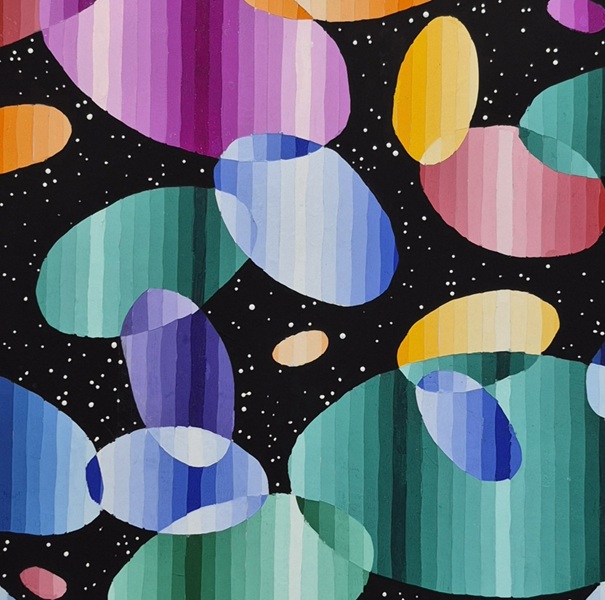
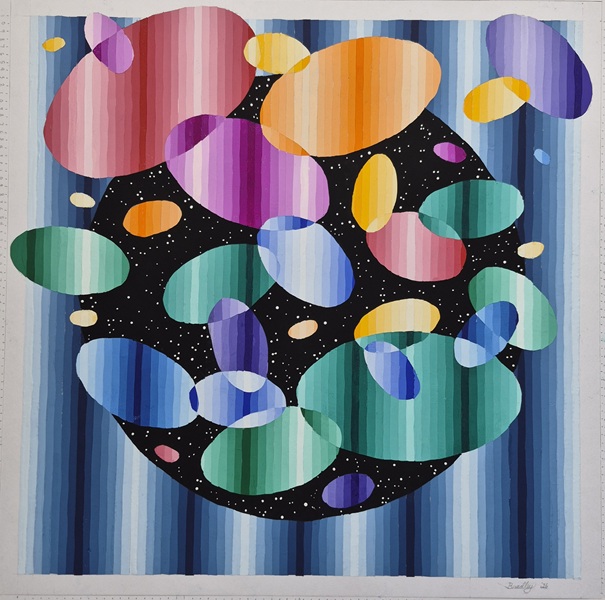
When I began to design this painting (yes) 9 months ago, I was interested
in seeing if I could draw some ovals while also seeing if I could vary
their sizes AND superimpose them over one another. Additionally, I was
curious if I could establish a tinting scheme which would be optimized for
contrast with respect to a tinted indigo background. The (very) complex task
of doing this became apparent when ovals "went over" or "under" other
ovals. The tinting had to be reversed in those areas to make the
intersections as obvious as possible. Two other "things" had to be
considered while all this tinting was going on. The more obvious thing was
that the 8 tints (from darkest to lightest) for ANY foreground ovals needed
to be opposite to the tinting of the indigo background (as mentioned).
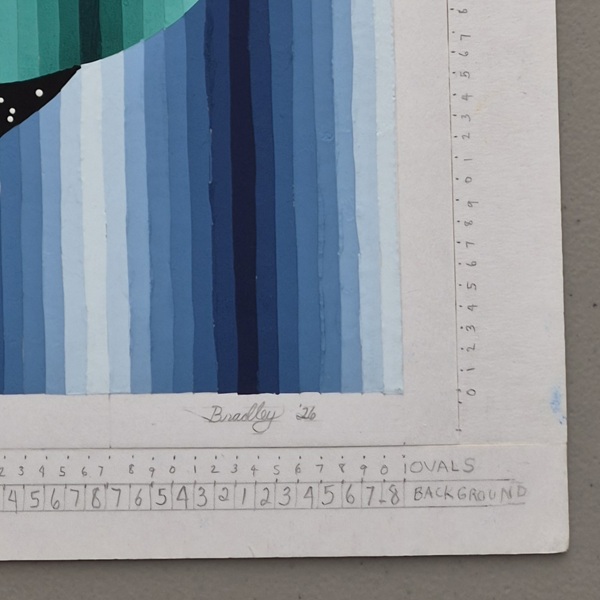
Around the painting border, I made a legend (for the background) and another one for
the ovals. (1,2,3,4,5,6,7,8,7,6,5,4,3,2,1 = foreground ovals) while the
backgound read: (8,7,6,5,4,3,2,1,2,3,4,5,6,7,8). The "opening" into the
universe was the final color painted. Stars were "painted" with the tip of a
nail.
I didn't know what to title this piece until the black sky and stars were
added. I did however want to say something about evolution in the life of
things -- all things (human and natural). The happy, colorful "dancing"
ovals seemed to convey an exuberant feeling and emotion of what eventually
I saw as joy. I liked the title also because it seemed to point to the
question we all at times have -- which is "where" and "how" joy arises?
Obviously it is a rather "formless" emotion, but it's origin is an
interesting thing. It evolves as the result of many contributing
"conditions." This is all very interesting since we "all" wish to be
"happy, joyous and free." The evolution has no "destination." It simply is
what it is. We know it when we experience it. We seek to Be with it at
those times, since it has such a simple, sacred and profound quality. And,
like many emotions, it too can be fleeting! Having the intention to be
joyful can certainly be helpful!
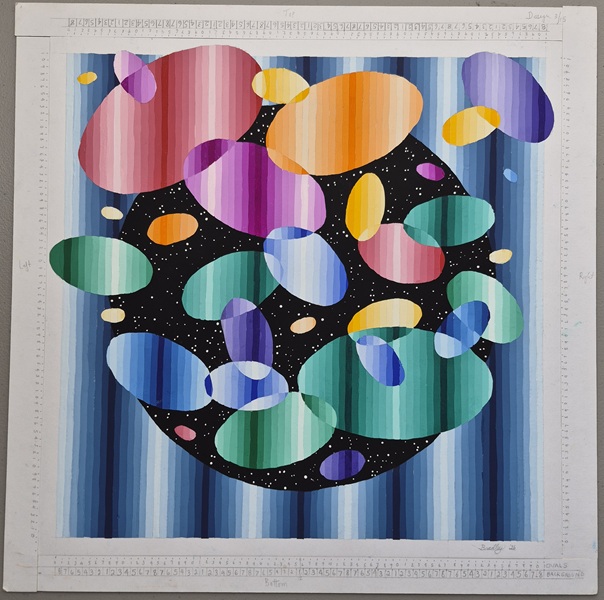
Below, you can see I have created a white mat-board "pocket" around the
entire illustration board. On these 4 narrow strips, I "labeled" the
columns with numbers for tinting. The image after this one shows this in
more detail.
Bottom-right corner (below) of the painting in more detail. The right side
numbering was not necessary to create as I did with the ascending and descending
numbers for top and bottom, but it was helpful for other reasons.
Below is a closer view of the center of the painting.