Speaking of Number Systems ...
http://primepuzzle.com/tunxis/margaret.html
Please click the above link to see both this text and the images.
I had a 20-minute tutoring session in Number Systems this morning. I was unable to solve the problem my student wanted help on but was later able to figure it out. IMHO, this seemingly "low level," "elementary" course is among the deepest and most complex Math courses offered at Tunxis and I am not surprised when students have difficulty with it. Another tutor later tutored the same student in the same subject and I could not help hearing some of the questions they discussed. Stuff like "show that 8128 is a perfect number" and "which primes must you use to determine if 599 is prime." The ideas of "look it up if you have no clue what a word means" and "try all primes less than the square root of the number in question" are pretty deep ideas ...
The problem my tutee and I were battling was this:
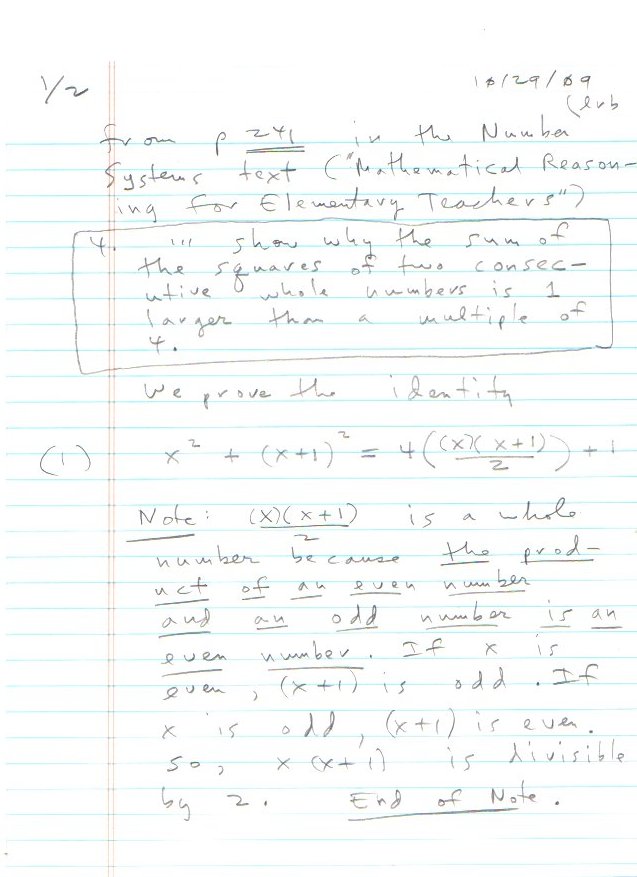
" ... show why the sum of the squares of two consecutive whole numbers is 1 larger than a multiple of 4."
Play student and see how long it takes you to prove this.
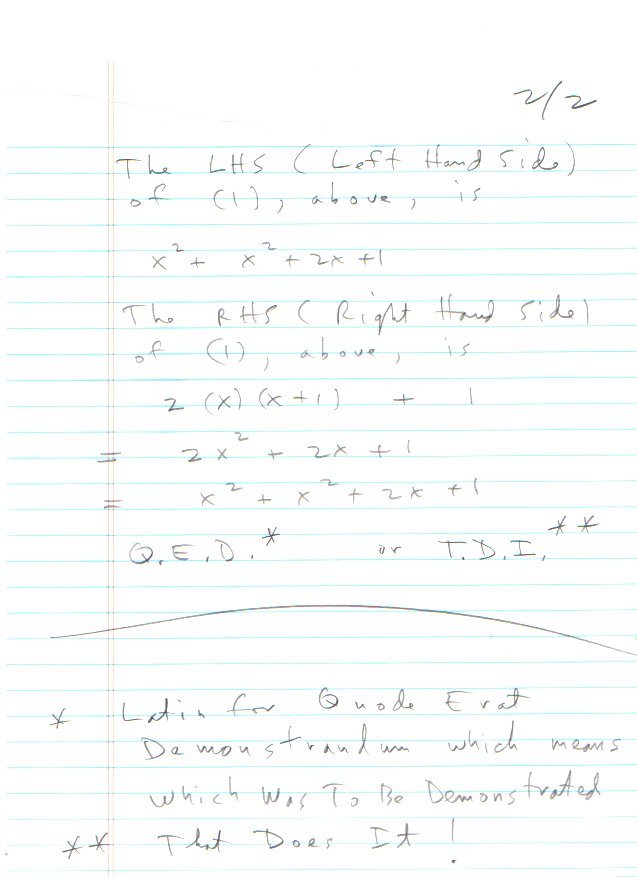
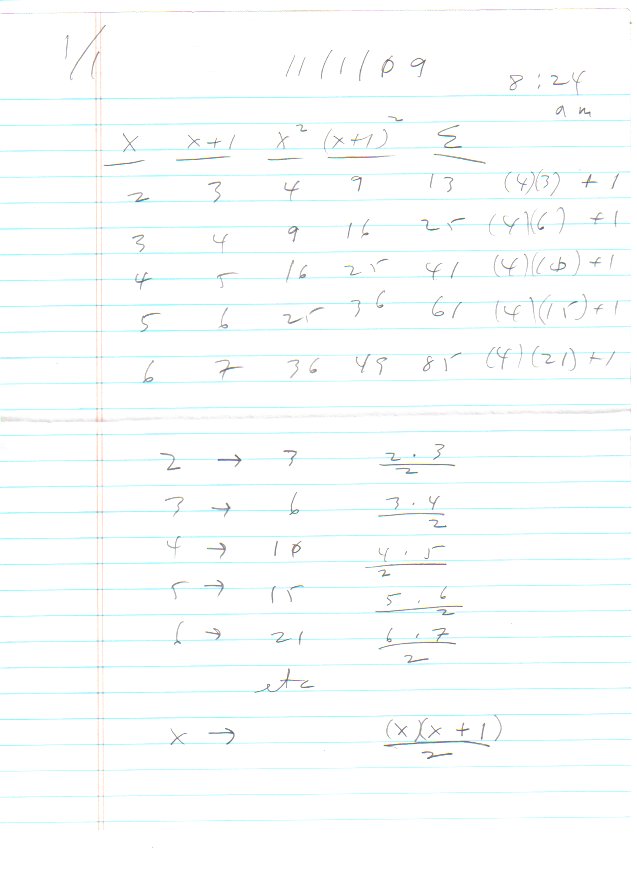
Some very basic properties of numbers and the whole idea of a proof are going on here. A scan of what I came up with follows. I'm embarrassed to tell you how many pieces of paper I scribbled on to eventually produce this. How I came up with the "identity" to be proved is pretty hard to explain.
The word "elementary" does not mean "easy." It means "fundamental."
For a "geometric view" of this, go to http://primepuzzle.com/tunxis/nt.html