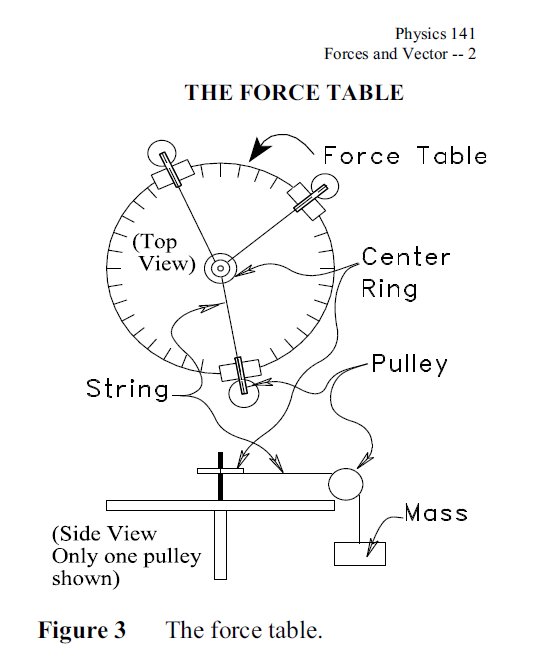
Download vectors.exe, a jigsaw puzzle game that uses the image below.
What if you had 5 pulleys positioned at 0 degrees, 72 degrees, 144 degrees, 216 degrees and alpha degrees (where alpha is not known). There is a 1 gram mass hanging at the end of the string at 0 degrees. There is a 2 gram mass hanging at the end of the string at 72 degrees. There is a 3 gram mass hanging at the end of the string at 144 degrees. There is a 4 gram mass hanging at the end of the string at 216 degrees. What mass would you have to hang at the end of the string at alpha degrees and what is angle alpha so the ring in the middle doesn't touch the post that "threads" it (i.e. so that the system is in equilibrium)?
By equating the total force to 0 we get the vector equation
F = (0,0) = (Fx,Fy) = (1*cos(0)+2*cos(72)+3*cos(144)+4*cos(216)+m*cos(α),1*sin(0)+2*sin(72)+3*sin(144)+4*sin(216)+m*sin(α))
Solving this 2-unknown, 2-equation system we get
1*cos(0)+2*cos(72)+3*cos(144)+4*cos(216)+m*cos(α) = 0
1*sin(0)+2*sin(72)+3*sin(144)+4*sin(216)+m*sin(α) = 0
The above implies
-(1*cos(0)+2*cos(72)+3*cos(144)+4*cos(216))/cos(α) = m
-(1*sin(0)+2*sin(72)+3*sin(144)+4*sin(216))/sin(α) = m
This implies
tan(α) = (1*sin(0)+2*sin(72)+3*sin(144)+4*sin(216))/(1*cos(0)+2*cos(72)+3*cos(144)+4*cos(216)) = 1.3143278/(-4.04508497) = -0.32491970
This implies
α= atan(-0.32491970) = -0.31415927 radians = 360/6.28318530*(-0.31415927) degrees = -18.00000029 degrees
Note: This result is probably really -18 = -72/4 (!)
Using this result and one of the above equations for m, we get
m = -(1*cos(0)+2*cos(72)+3*cos(144)+4*cos(216))/cos(-18.00000029) = 4.25325405 grams