Nhung -
That problem I mentioned last night has been bugging me. It's
from page 440 problem 69 in the Intermediate Algebra text.
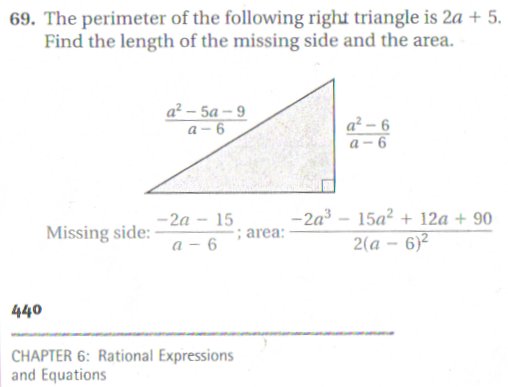 I get the answers for the questions they ask. They give you the
perimeter of the triangle and from this you can determine the length of
the second leg.
This length is (-2a-15)/(a-6).
Using x instead of a, the expression on the RHS of the first function
below must equal 0 (Pythagorean Theorem). Using an online function
evaluator, you can see that the variable a must equal approx. -2.5213.
The last three functions (lengths of leg, leg, hypotenuse) show that the
sides of the triangle are approx. 1.17, 0, and -1.2. Since you can't
have a negative length, this can't be describing a real right triangle.
y(x)=(2x+15)^2+(x^2-6)^2-(x^2-5x-9)^2
y(x)=(-2x-15)/(x-6)
y(x)=(x^2-6)/(x-6)
y(x)=(x^2-5x-9)/(x-6)
Unless I'm missing something.
I get the answers for the questions they ask. They give you the
perimeter of the triangle and from this you can determine the length of
the second leg.
This length is (-2a-15)/(a-6).
Using x instead of a, the expression on the RHS of the first function
below must equal 0 (Pythagorean Theorem). Using an online function
evaluator, you can see that the variable a must equal approx. -2.5213.
The last three functions (lengths of leg, leg, hypotenuse) show that the
sides of the triangle are approx. 1.17, 0, and -1.2. Since you can't
have a negative length, this can't be describing a real right triangle.
y(x)=(2x+15)^2+(x^2-6)^2-(x^2-5x-9)^2
y(x)=(-2x-15)/(x-6)
y(x)=(x^2-6)/(x-6)
y(x)=(x^2-5x-9)/(x-6)
Unless I'm missing something.  Do you see what I mean?
- Lee
Do you see what I mean?
- Lee